 Zephyrhills Mobile Home Leveling
 Mobile Home Leveling in Zephyrhills
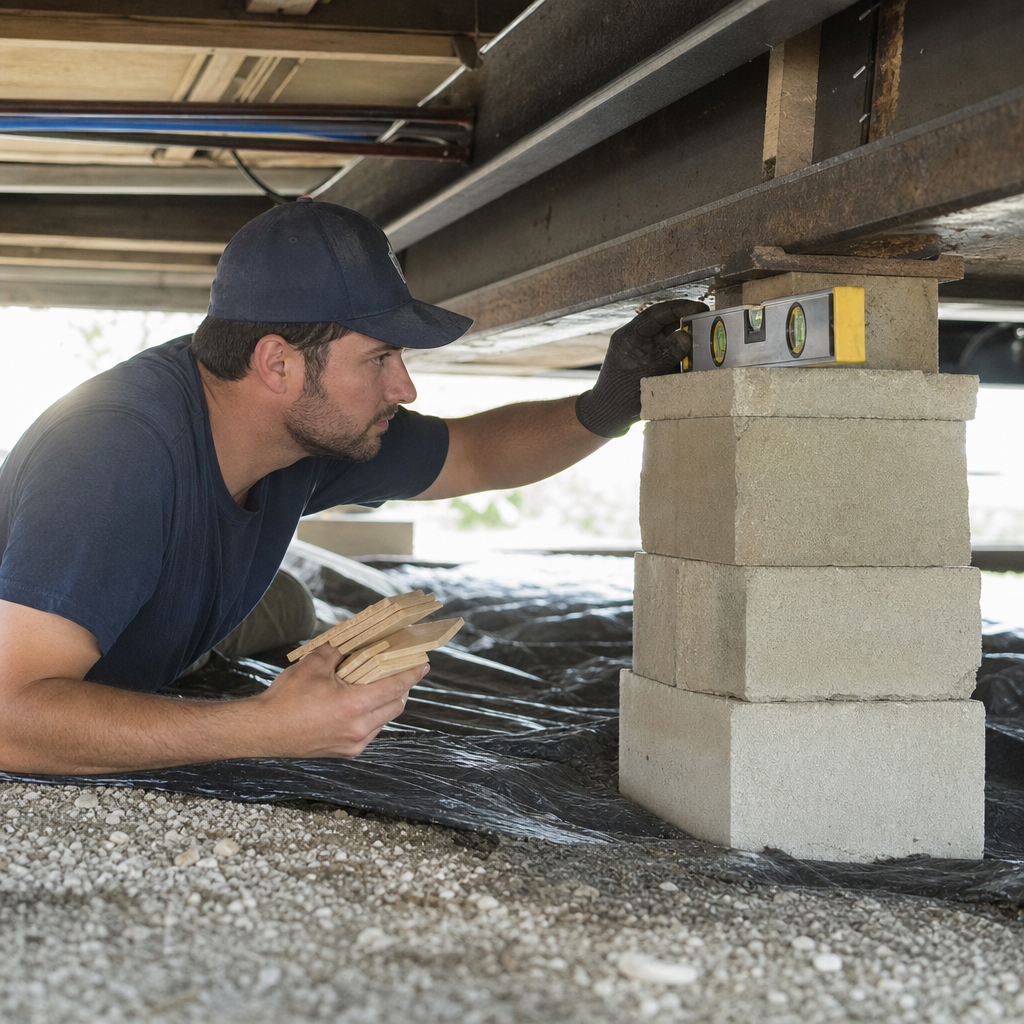
Mobile home leveling, releveling in the trade, is the job of putting a settled manufactured home’s steel chassis back on one flat plane. In Zephyrhills that means a crew under the home with a water level, 20-ton hydraulic bottle jacks on solid cribbing, and a bundle of hardwood shims, rebuilding each low pier until every I-beam reads level again. A singlewide relevel runs $450 to $800 and a doublewide $750 to $1,400, almost always in one day, and the survey that tells you what your home needs is free.
Zephyrhills owners tend to call after the summer rains, when a door that rubbed a little in May will not latch at all in October. That is the ground talking, and it is worth understanding before the crew arrives.
Why Zephyrhills homes go out of level
The parks along Chancey Road, Gall Boulevard, Lane Road, and SR-54 sit on two kinds of ground, and both move. The USDA soil survey maps the ridges around Zephyrhills as Tavares, Astatula, and Candler sands, deep, loose, and rated moderately well to excessively drained, with water tables deeper than 80 inches on the Candler. Between the ridges are the flatwoods soils, Myakka, Pomona, Wauchula, and Ona, all of which NRCS classes as poorly drained and which sit saturated for weeks in a normal summer.
A pier footing on ridge sand sinks because loose sand consolidates under a concentrated load and migrates when rain runs through it. A pier footing on flatwoods sand sinks because saturated sand simply carries less. Either way, the pier on the wettest ground drops first. The frame above it twists by a fraction of a degree, the wall over it leans, and the door opening that was a rectangle becomes a parallelogram. Doors are precise objects. They report it first.
Then the rain arrives on schedule. NOAA’s 1991 to 2020 normals for the St. Leo station, about nine miles northwest, put annual rainfall at 52.48 inches with 32.37 of it in June through September. August alone normals 9.33 inches. Most of that comes as afternoon downpours that run off the roof, out a downspout, and under the skirting. On this cycle a relevel every three to five years is ordinary maintenance.
How the job is done
1. Map the frame. Skirting access panels come off and our crew goes under the home end to end. Every pier is shot with a water level (a rotary laser on some jobs) against a datum pier, usually the most stable one. Each I-beam gets a reading. The result is a map of exactly which piers dropped and how far, to a fraction of an inch. While under there we handle every pad, cap, and shim stack for crush and rot, looks at the belly for tears, and checks every anchor strap for tension and rust. On a doublewide, the marriage-line pier row down the center gets its own readings against both outer beams.
2. Set the lift. Solid wood cribbing goes down near each low pier, and a 20-ton bottle jack sits on the cribbing at the frame. We lift in small increments and work back and forth across the frame rather than cranking one point up to grade. Raising one corner far out of plane is what cracks drywall, pops trim, and opens ceiling seams, and a competent crew never does it. Nobody works under a home held by a jack alone; the cribbing carries the load at every stage.
3. Rebuild the piers. As each section comes up to the line, the pier under it gets rebuilt: blocks re-stacked or replaced, crushed caps and pads swapped out, and hardwood shims driven tight in opposing pairs between the cap and the I-beam. Florida Rule 15C-1.0102 requires piers to bear on a solid concrete pad of at least 4 by 16 by 16 inches on cleaned, graded ground, and HUD’s installation standard limits how much shim and lumber can stack on a pier. A pier that would need a tall stack to reach the beam gets rebuilt at the right height instead, priced per pier on the pier and pad repair schedule.
4. Verify. The whole frame is re-shot. Every reading has to land on the line, and every pier has to be carrying load, which we check by hand, because a pier you can rattle is holding up nothing. On a doublewide, we confirm the marriage line has closed back up at ceiling and floor.
5. Re-secure. Anchor straps are re-tensioned, because raising the home changed the tension they were set at. Skirting goes back on. Any belly damage or anchor shortfall found on the survey is written up so you can schedule it, not buried in the invoice.
Singlewides take three to five hours. Doublewides take six to eight. Low clearance, standing water, or several full pier rebuilds can push a job into a second day, and you hear that at the survey.
What it costs, and what moves the number
| Home | Relevel |
|---|---|
| Singlewide | $450 to $800 |
| Doublewide | $750 to $1,400 |
| Pier reset or reshim, if needed | $75 to $150 per pier |
| Pier rebuild, if needed | $150 to $400 per pier |
A home releveled on a three-year cycle, with sound pads and only a few piers to reshim, sits at the bottom of its range. A home that has gone ten years, with 1990s shims rotted to punk and two piers carrying nothing, sits at the top with pier work added. The pricing page covers every range we charge.
Signs it is time
- Doors that rub, drag, or will not latch, especially clustered at one end of the home.
- Windows binding in their tracks.
- Floors that slope or bounce; the rolling-marble test.
- Cracks over doorways and at ceiling joints.
- A gap along a doublewide’s marriage line, at the ceiling or a ridge at the floor.
- Skirting bowing or popping off its track as the home settles onto it.
A single sticking door in August might be humidity; Florida doors swell. A pattern is the frame. Any pattern earns a free level check.
The licensing rule, stated plainly
Section 320.8249 of the Florida Statutes requires anyone who installs a mobile home to hold a mobile home installer license issued by the Florida Department of Highway Safety and Motor Vehicles, and Rule 15C-1 sets the installation standards that blocking, leveling, and anchoring have to meet. That includes releveling a home that is already sitting in a Zephyrhills park. Before any leveling, ask whoever does it, us included, for a state license number. The under-home fingerprints of unlicensed work, shim stacks past the HUD limit, scrap-lumber caps, a corner cranked up until the ceiling split, are what licensed crews spend half their time undoing at rebuild prices.
One honest thing
On this sand, a relevel is periodic maintenance. Unless the drainage problem under a home is fixed, the downspout dumping at a pier, the low side of the lot holding water, the pad set on unprepared ground, it comes back in a few years. We point those things out while we are under there. Parks off Chancey Road, Gall Boulevard, and SR-54, and owned-land homes toward Crystal Springs or Dade City, are all inside our map. The free check is usually a couple of days out and the written price comes the same day we shoot your piers. Read the FAQ or book the check.
Frequently Asked Questions
How much does it cost to level a mobile home in Zephyrhills?
Singlewides run $450 to $800 and doublewides $750 to $1,400. Size, how far out of level the frame reads, how many piers need rebuilding rather than reshimming, and access under the home decide where a job lands. The survey is free and the price is written at the home before any lifting.
What is a water level and why does it matter?
A clear tube filled with water: the surface at both ends is always at the same height, so the crew can read every pier against one reference point with no line-of-sight error and no battery. Shooting each pier off a datum pier produces a number per pier, which is what tells you which ones dropped and by how much, and it is what the written quote is built on.
Can I stay in the home during the relevel?
Yes. The lift is gradual, a fraction of an inch at a time across several stations, and the crew is under the home rather than in it. Most owners notice the doors start closing again before the crew has packed up.
Why do you re-tension the straps after leveling?
Because raising the frame changes the tension every strap was set at. A settled home has slack straps, and a freshly raised one has slacker ones. Re-tensioning is part of every relevel by default, and if the anchor system itself is short or corroded you get that quoted separately rather than folded in.
How soon after the summer rains should I have it checked?
October is the classic month, and not by accident: NOAA's normals for the St. Leo station put 62 percent of the year's rain into June through September, and the piers move most in those months. If a door has started sticking, book the free check. If nothing is wrong yet and the last relevel was more than three years ago, book it anyway.
More mobilehome services
- Mobile Home Pier & Pad Repair in Zephyrhills
- Mobile Home Tie-Downs & Anchors in Zephyrhills
- Mobile Home Vapor Barrier Replacement in Zephyrhills
- Mobile Home Skirting Repair in Zephyrhills
- Pre-Sale Mobile Home Leveling Inspection in Zephyrhills
- Mobile Home Transport & Setup in Zephyrhills
- Mobile Home Roof-Over and Roof Coating in Zephyrhills