 Zephyrhills Mobile Home Leveling
 Mobile Home Pier & Pad Repair in Zephyrhills
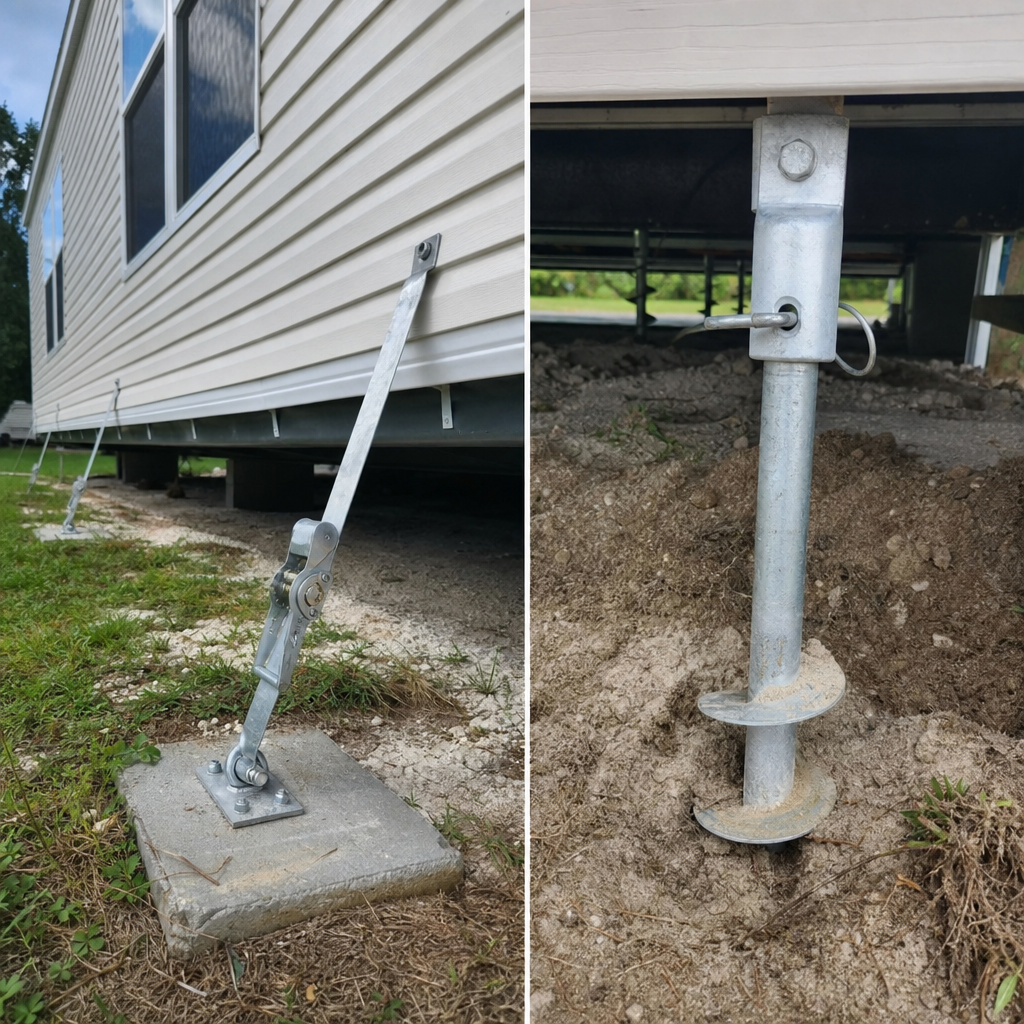
Pier and pad repair is the part of a relevel that deals with the supports themselves: the concrete footing pad on the ground, the stack of concrete blocks on top of it, the cap and hardwood shims between the block and the steel I-beam. In Zephyrhills, where the piers stand on deep sand that consolidates and washes every rainy season, that work is the difference between a home that stays level for years and one that is back out of plane by the next October. Resets and reshims run $75 to $150 per pier, full rebuilds $150 to $400 per pier, and the survey that finds which piers need which is free.
What a pier is, and what fails
A manufactured home rests on two steel I-beams running the length of the chassis, with a third row down the marriage line on a doublewide. Every few feet along each beam sits a pier. Florida Rule 15C-1.0102 sets the minimum foundation for each one at a 4-inch by 16-inch by 16-inch solid concrete pad, precast or poured 8 inches in place, on ground that has been cleared of vegetation and organic material and graded to drain. On the pad sits a stack of concrete blocks with a minimum 2,200-pound flexural strength, on the blocks a cap, and between the cap and the beam the hardwood shims that make the last fraction of an inch tight.
Each of those parts fails in its own way:
- Pads sink or tilt. The pad presses on sand. On the ridge soils NRCS maps around Zephyrhills, Tavares, Astatula, and Candler sands, the sand under the pad consolidates under load and migrates when rain runs through it. On the flatwoods soils between the ridges, Myakka, Pomona, Wauchula, and Ona, all rated poorly drained, the pad sits in saturated ground for stretches of the summer and one side of it settles more than the other. A tilted pad throws the whole stack out of plumb.
- Blocks crack or shift. A pier that has been lifted and reshimmed many times over decades, or one that was never square to begin with, ends up with blocks offset or split.
- Caps crush. The cap is where the pier meets the beam. Decades of load on a cap that was undersized or made of scrap lumber crush it into the top block.
- Shims rot or over-stack. Hardwood shims exposed to a wet belly rot to punk. And every quick relevel that added another shim instead of rebuilding the pier pushes the stack past what HUD’s installation standard allows on top of a pier.
That last one is common in the older Zephyrhills parks. A home set in a 1970s or 1980s park has often had a dozen relevels, and if a few of them were handyman jobs we find shim stacks two and three inches tall, lumber blocks for caps, and piers that would need to be dismantled to fix properly. That is the moment a reshim becomes a rebuild.
Reset versus rebuild
A reset or reshim is what a sound pier gets during a relevel. The pad and blocks are fine; the frame has lifted off the cap by a fraction of an inch and needs new shims driven tight. $75 to $150 per pier, and most piers on a home that has been on a regular cycle are this.
A rebuild is for a pier that cannot be made right by shimming. We lift the beam onto cribbing, dismantle the pier, dig and clean a fresh bed for the pad, set a new pad on undisturbed compacted ground, re-stack new blocks square and plumb, fit a new cap, and shim to a tight fit inside the HUD allowance. $150 to $400 per pier depending on height, access, and whether the pad bed needs fill and compaction.
The survey marks each pier on the map as one or the other, and the written quote lists them by number so you can see exactly what was done under your home.
What a typical Zephyrhills pier job looks like
A singlewide on Gall Boulevard that has not been touched since the early 2000s. The water level finds the west beam low by an inch and a quarter at the rear, tapering to level at the front door. Four piers at the rear are carrying almost nothing. Two of them have crushed caps and pads that have sunk into the sand at an angle; two have sound pads but three-inch shim stacks from previous quick fixes. The job: relevel the home (singlewide, $450 to $800), rebuild the two piers with tilted pads and the two with over-tall stacks (four rebuilds at $150 to $400), reshim the six piers along the same side that have opened small gaps (six resets at $75 to $150). All-in, the job lands in the middle of the $500 to $2,500 range for pier-and-pad work on top of the relevel, and it is itemized to the pier.
A doublewide at one of the Chancey Road communities with a marriage-line gap at the ceiling. The center row has settled where the ground holds water; the outer beams read fine. The job is three or four center-row rebuilds, a doublewide relevel to close the seam, and a note about the downspout dumping at that end of the home.
Drainage, or it comes back
A rebuilt pier on the same wet ground will settle again. We look at why the ground under a failed pier is wet: a downspout with no splash block, a low lot edge that holds water, skirting with no ventilation trapping moisture, a belly tear dripping condensate onto the pad. Some of those are five-minute fixes you can do yourself. Others, like a vapor barrier repair or a skirting fix, get quoted on the same visit so you can decide. None of it is upsell; it is what keeps the next relevel three to five years away instead of eighteen months.
Licensed work, and why it matters on piers specifically
Section 320.8249 of the Florida Statutes requires a mobile home installer license from the Florida Department of Highway Safety and Motor Vehicles for anyone installing a mobile home, and Rule 15C-1.0102 says every pier, anchor, and tie-down component used in an installation has to be tested, listed, and approved by that department’s Bureau of Mobile Home and Recreational Vehicle Construction. Pier rebuilds are where unlicensed work does its worst: pads set on loose fill, blocks stacked on soil with the organic layer still in it, caps made of whatever was in the truck. Pier and pad work should be done by a licensed installer, with approved components, on cleaned and compacted ground.
Book the survey
If a door at one end of your home has stopped latching, a floor has developed a lean, or a skirting panel has bowed where the home is coming down onto it, the piers under that end have moved. The free level check maps every pier, marks the ones that need a reset and the ones that need a rebuild, and writes the price at the home. The service covers Zephyrhills plus Dade City, Wesley Chapel, Land O’ Lakes, Crystal Springs, and Plant City, at the same published prices everywhere.
Frequently Asked Questions
What does pier repair cost in Zephyrhills?
Resetting or reshimming a sound pier during a relevel runs $75 to $150 per pier. Rebuilding a pier with a new pad, new blocks, and a new cap runs $150 to $400 per pier. Most pier-and-pad jobs land between $500 and $2,500 all-in, itemized per pier on the written quote.
How do I know whether a pier needs a reset or a rebuild?
The survey decides it. A pier with a sound pad and sound blocks that has just opened a gap gets reshimmed. A pier whose cap is crushed into the top block, whose pad has tilted or sunk into the sand, or that would need a stack of lumber beyond the HUD limit to reach the beam gets rebuilt. Each pier is marked on the map with which one it is.
Why do pads sink faster here than in other parts of Florida?
Deep, loose sand on the ridges and saturated sand in the flatwoods. Florida's rule tells installers to assume 1,000 pounds per square foot of soil bearing and requires at least a 16-by-16 concrete pad, but a pad that size on Tavares or Candler sand consolidates its footing every wet season, and a pad on Myakka or Pomona sits in saturated ground for weeks each summer.
Can a pier be repaired without releveling the home?
A single failed pier can be rebuilt on its own, but by the time one pier has visibly failed the frame has usually moved, so pier work and a relevel almost always go together. The survey shoots the whole frame either way, and if the rest of the home reads level you are told that and only the one pier is quoted.
More mobilehome services
- Mobile Home Leveling in Zephyrhills
- Mobile Home Tie-Downs & Anchors in Zephyrhills
- Mobile Home Vapor Barrier Replacement in Zephyrhills
- Mobile Home Skirting Repair in Zephyrhills
- Pre-Sale Mobile Home Leveling Inspection in Zephyrhills
- Mobile Home Transport & Setup in Zephyrhills
- Mobile Home Roof-Over and Roof Coating in Zephyrhills